

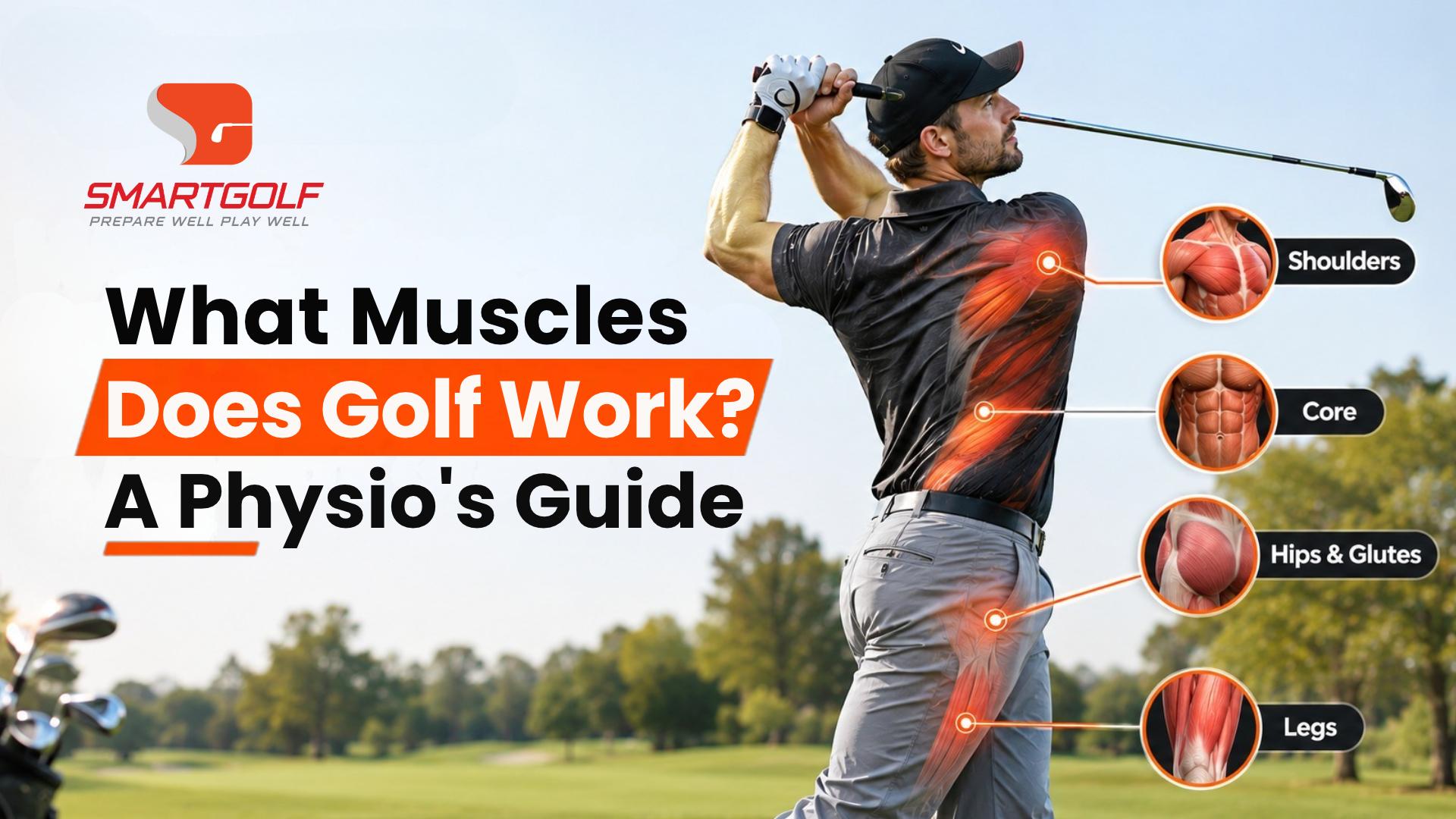

How many muscles are used in a golf swing?
There is no single agreed number, because almost every muscle in the body plays some role, even if it only steadies a joint. What matters more is that a handful of large muscle groups do most of the work. Train those well, and you will see the biggest gains in speed, consistency, and injury resistance.The most important muscles for golf
| Muscle group | Main job in the swing | Why it matters |
| Glutes | Drive hip rotation and stabilize the legs. | The biggest source of power |
| Quadriceps and hamstrings | Push into the ground and control the knees | Create and absorb force |
| Core and obliques | Transfer force and control rotation | Link the lower and upper body |
| Upper back and lats | Turn the torso and pull the club down. | Add speed and support posture. |
| Shoulders and rotator cuff | Control the arms and club. | Protect the shoulder. |
| Forearms and grip | Hold and release the club. | Control the clubface. |
| Calves and feet | Balance and push off the ground. | A stable base for everything else |
Glutes: your power muscles
The glutes are the largest muscles in your body, and they are the engine of the golf swing. In the backswing, the trail-side glutes help you load into your trail hip. In the downswing, the lead-side glutes help you rotate and post up on your lead leg. Weak glutes are one of the most common reasons golfers lose distance. They also mean the lower back has to work harder to turn the body, which is a common cause of back pain.Legs: quadriceps and hamstrings
Your legs push against the ground to create force. The quadriceps on the front of the thighs control your knee flexion and help you push up through impact. The hamstrings on the back of the thighs work with the glutes to drive the hips and hold your posture. To see how this ground force becomes clubhead speed, read our guide on where power comes from in the golf swing.Core and obliques: the link in the chain
The core is not just your six-pack. It includes the obliques on the sides of your trunk, the deep abdominal muscles, and the muscles along your spine. In golf, its main job is to transfer force from the legs to the upper body and to control rotation. The obliques help rotate the torso. The deeper muscles stop the spine from moving too much, which protects it. A strong core makes your swing more repeatable and protects your lower back.Upper back and lats
The latissimus dorsi, or lats, are the large muscles on the sides of your back. They help turn your torso and pull the club down in the downswing. The muscles between your shoulder blades hold your posture, so you can keep your spine angle through the swing.Shoulders and rotator cuff
Your shoulders guide the arms through a big range of motion. The rotator cuff is a group of four small muscles that keep the shoulder joint stable. Golf asks the rotator cuff to control very fast movements, so it needs to be strong to prevent shoulder pain.Forearms, wrists, and grip
Your forearm muscles control your grip and wrist hinge and help square the clubface at impact. They also take the shock when the club hits the ground. Weak forearms are linked to golfer's elbow and wrist pain.Calves and feet
Your feet are your only contact with the ground. The calves and small muscles of the feet give you balance and help you push off. Poor balance anywhere above usually shows up as poor footwork.Which muscles add the most power?
Most power comes from the glutes, legs, and core. The arms and shoulders deliver it to the club, but they cannot create it on their own. This shapes how you should train:- Lower body: heavier, slower strength work such as the back squat, trap bar deadlift, and rear elevated split squat.
- Upper body: lighter, faster work such as the Medicine Ball Throw, bench throw, and plyo press-up.
- Speed: regular fast swings, ideally with a radar, so your nervous system learns to use the strength you have built.
Is there a muscle that isn't used in the golf swing?
Not really. Even muscles that do not produce force, such as those in the face, neck, and lower legs, help steady the body. Some muscles do more than others, but in a full-body movement like the golf swing, almost every muscle contributes something.Does golf build muscle?
Not much. The golf swing is fast and powerful, but the club is light, and each swing is over in a second. That is not enough resistance to make muscles grow or get much stronger. Does swinging a golf club build muscle? Not on its own. Playing and practicing will keep your golf muscles active, and walking the course is good for your legs and heart. But to build strength, you need resistance training. In fact, golf can create imbalances because you rotate in one direction thousands of times. That is why balanced strength work matters. And no, lifting weights will not make you too bulky to swing. We explain why is weight training bad for golfers?The best exercises to strengthen your golf muscles
These golf strength exercises cover every major muscle group in this guide. Do them two or three times a week.| Exercise | Main muscles | Sets and reps |
| Front Squat | Quads, glutes, core | 3 x 6 to 8 |
| Trap Bar Deadlift | Glutes, hamstrings, back | 3 x 5 |
| Hamstring Bridge | Hamstrings, glutes | 3 x 8 |
| DB Rear Elevated Split Squat | Quads, glutes, balance | 3 x 8 for each leg |
| Eccentric Pallof Press | Core and obliques | 3 x 5 each side |
| Standing Russian Twist | Obliques, rotation | 3 x 6 each side |
| Plank | Deep core | 3 x 30 seconds |
| Pendlay Row | Lats, upper back | 3 x 6 |
| Pull Up | Lats, upper back, grip | 3 x 3 to 6 |
| Band external rotation | Rotator cuff | 2 x 15 each side |
| Wrist curls and extensions | Forearms | 2 x 15 |
| Medicine Ball Throw | Whole chain, power | 3 x 5 each side |
What happens when golf muscles are weak
Weak or tight muscles force other areas to compensate. Common examples include:- Weak glutes and stiff hips lead to the lower back over-rotating. Read more about why your lower back hurts after golf.
- A weak rotator cuff can cause shoulder pain, especially in the lead shoulder.
- Weak forearms increase the risk of golfer's elbow and wrist problems.
- A weak core leads to a swing that changes from shot to shot.
