

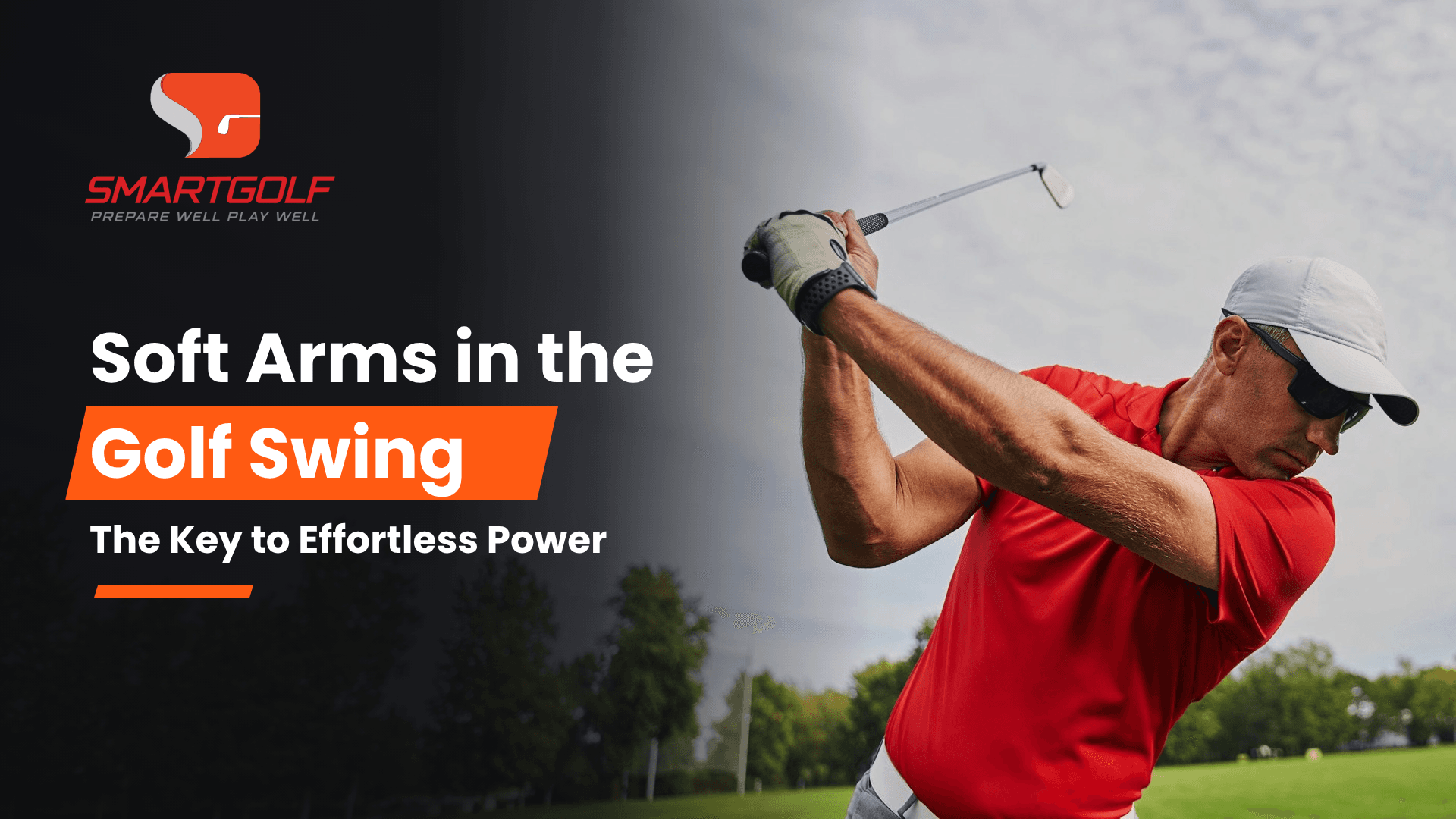

How to relax arms in golf swing:
Your arms and hands are the last link between your body and the club. Their job is to transfer the speed your body creates, not to create it. For that transfer to work, they need to stay relaxed so the club can whip through at the bottom. Soft arms mean:- A light grip pressure. On a scale of 1 to 10, aim for about a 4 or 5, firm enough to control the club but no tighter.
- Relaxed forearms and shoulders. No bracing, no squeezing, no lifting your shoulders towards your ears.
- Arms that hang and swing freely, pulled by the turn of your body rather than driven by their own muscle.
Why arm tension slows the club down
This is the part that surprises people. Swinging harder with tense arms usually makes the club slower, not faster. When you grip hard and tense your arms, three things happen:- Opposing muscles fight each other. Tension switches on muscles that work against your swing, so you are effectively braking and accelerating at the same time.
- The club cannot release. A free release, where the clubhead passes your hands through impact, is where a lot of speed comes from. Tight hands and arms hold that release back.
- Your sequence breaks down. Tense arms tend to take over and start the downswing early, which ruins the order that creates speed. We explain that order in our guide to where power comes from in the golf swing.
Soft arms and a better strike
Speed is only half the story. Soft arms also improve how cleanly you strike the ball. Tension makes your movements jerky and harder to repeat, so your low point moves around, and you catch the ball thin or heavy. Relaxed arms move more smoothly and consistently, which helps you return the club to the same place time after time. Many golfers find that simply relaxing their grip fixes a run of poor contact. Soft arms help your short game too. Chipping and pitching rely on feel, and feel disappears when your hands are tight. A softer grip lets you sense the clubhead and control distance far better.How to train soft arms
You cannot just tell yourself to relax and expect it to stick, especially under pressure. These drills build the feel.- The grip-pressure check. Before each swing, set your grip and consciously ease your pressure to about a 4 out of 10. Waggle the club gently to feel the clubhead. Do this as part of your pre-shot routine until it becomes automatic.
- The "swish" drill. Turn a club upside down and hold it by the head, so the grip end is light. Swing it and listen for the swish. The swish is loudest, meaning the club is fastest, when your arms are relaxed, and the swish happens past the ball, not before it. Tense arms move the swish back and make it quieter.
- Feet-together swings. Hit easy shots with your feet together. This forces you to swing smoothly and in balance, which only works with relaxed arms. If you tense up, you lose your balance.
- Slow-motion rehearsals. Make slow, full swings, feeling your arms hang and swing freely, pulled by your body. Then speed them up gradually while keeping that same relaxed feel.
- Breathe out before you swing. A slow breath out before you start lowers tension through your whole body, including your arms and hands. It is one of the simplest ways to soften up on the course.
Why you tense up in the first place
Understanding the cause helps you fix it. Golfers usually tense their arms because of:- Trying to hit it harder. The instinct to "give it a smash" tightens everything. Learning to swing faster, not harder, is the real answer.
- Pressure and nerves. The first tee, a tough shot over water, is a card that is going well. Tension rises with nerves, which is why your warm-up swings often feel freer than the real thing.
- A weak or unsure body. If your legs, hips, and core are weak, your arms try to make up the difference by muscling the club. Building strength in the right places lets your arms relax, which is part of what a structured strength program is designed to do.
- Cold muscles. Swinging without a warm-up makes you stiff and tense. A proper pre-round warm-up helps you start loose.
