

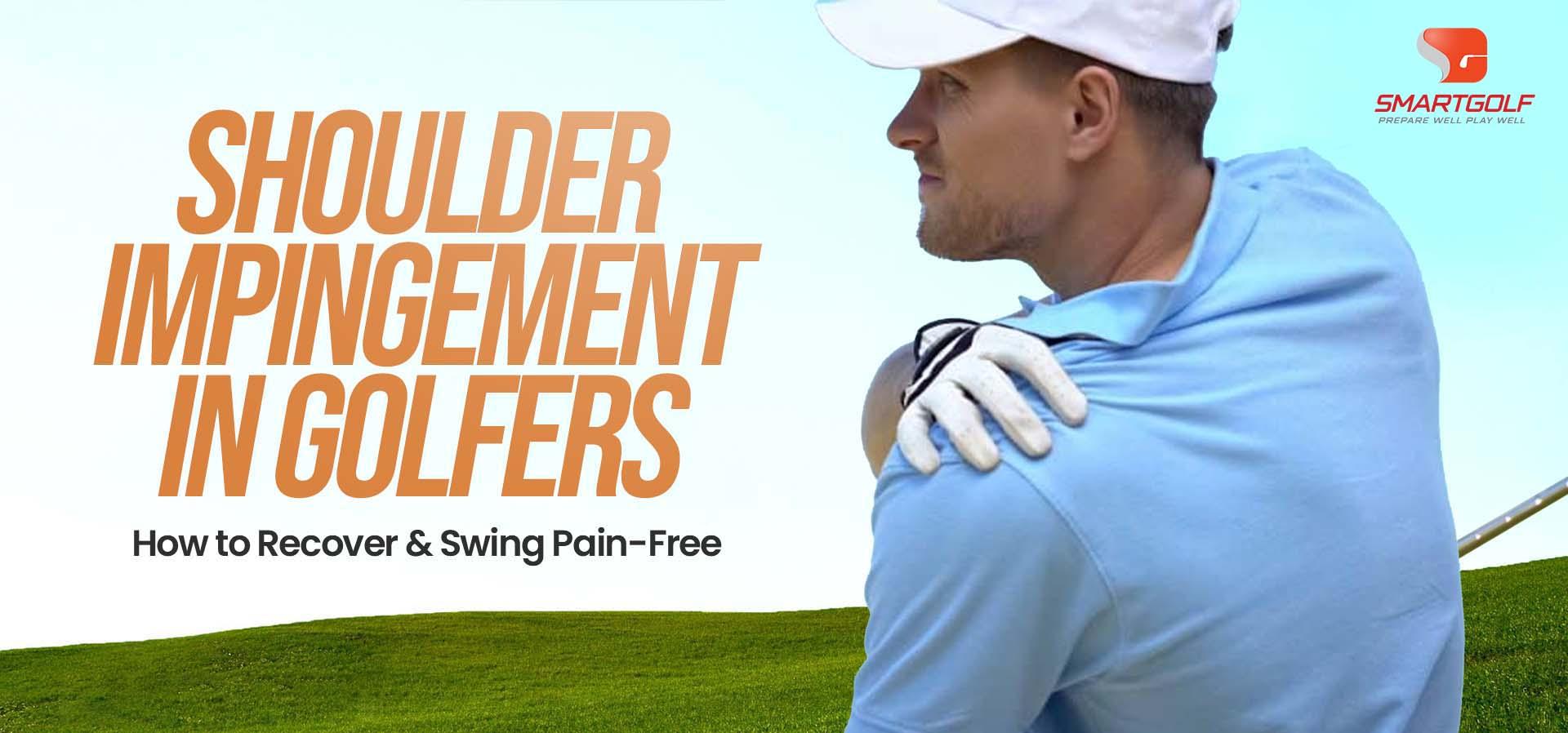

What shoulder impingement actually is:
Inside your shoulder, there's a narrow space where tendons pass beneath a bony arch. Impingement happens when that space narrows, or those tendons get irritated and start catching as you move, pinching, in effect, every time you lift or rotate the arm. In golf, the lead shoulder (the left for a right-handed player) is most exposed, taking significant load through the top of the backswing and into the follow-through.How to recognise it:
A few signs point toward impingement rather than ordinary soreness:- Pain when you raise your arm, particularly in an arc around shoulder height.
- A catching or pinching sensation, not just a dull ache.
- Discomfort at the top of the backswing or through the follow-through.
- Pain when lying on that shoulder at night is a classic tell.
- Weakness or reluctance to reach overhead.
Why golfers get it:
Impingement usually comes from a combination of tight or stiff shoulder and mid-back mobility, weakness in the muscles that stabilise the shoulder blade, and repetitive overhead-style loading from the swing. Age and posture play a part too. Importantly, golf itself doesn't do much to protect you here. A question we're often asked is: does golf build muscle, and the honest answer is not really. Does golf build muscle in the shoulder that would stabilise and protect it? No, the swing loads the shoulder without strengthening it, which is exactly why golfers need dedicated strength work to keep the joint resilient. Relying on the game alone leaves the shoulder exposed.Getting back to play:
If you've caught it early, the path back is usually straightforward: relative rest from the aggravating movements (not total inactivity), gentle mobility to keep the joint moving, and then progressive strengthening of the stabilising muscles around the shoulder blade and rotator cuff. Rushing back to full swings before that strength is rebuilt is the most common reason impingement lingers. But if the pain is sharp, persistent, waking you at night, or not improving after a couple of weeks of sensible management, get it assessed properly. Smart Golf's Rehab Programme is physio-led and built for exactly this: identifying what's driving the impingement and rebuilding the shoulder in the right order so you come back robust, not fragile.Preventing it in the first place:
The same work that rehabs a shoulder prevents one. Shoulder and thoracic mobility keeps the joint moving freely; rotator cuff and shoulder blade strengthening keeps it stable under load. This is where a golf workout program earns its place: a complete golf workout program covers the whole body, including the shoulder stability most golfers neglect until it's too late. Protecting the shoulder is far easier than rehabbing it, and it's one of the areas our most common golf injuries guide flags as most preventable. The same principle applies to the wrists and elbows at the other end of the arm.Making it stick:
Prevention and recovery both depend on consistent work. That's what Smart Golf is designed to support. The reminders prompt you when a session is due, and the leaderboards make your consistency visible:- Birdie (–1): completed on the scheduled day.
- Par (0): completed late, but before your next session.
- Bogey (+1): session missed.
