Neck Pain on the Physio Truck
Neck pain is probably the most common complaint we hear about on the physio truck—just behind the usual complaints of slow play, early tee times, late tee times, and poor form. It’s rarely tournament-ending, but it can quietly limit performance.
Players often describe a dull ache or tightness across the upper traps, particularly when rotating the head. This discomfort tends to show up at the top of the swing or through impact—right where control and timing are crucial.
Why Do Golfers Get Neck Pain?
There’s plenty of debate. Most players will blame a bad pillow from the cheap Airbnb they’re renting for the week—and to be fair, neck pain often feels worse first thing in the morning.
But in reality, the cause is
multifactorial. Recent research by Will Wynter Bee has found strong links between injury and periods of stress on the DP World Tour. That’s no surprise: the relationship between pain and mental health is well established, and professional golf is a high-stress environment.
A dip in form can quickly become a financial drain, with only about 65 of 145 players earning a pay cheque each week. Prolonged poor performance raises the risk of losing a tour card. Meanwhile, the Challenge Tour continues to strengthen, with the standard at the top end now very close to DP Tour level.
All of this adds up to
chronic stress—a key amplifier for both physical and perceived pain.
The Mechanics Don’t Help Either

Even without stress or dodgy bedding, the golf swing itself can be tough on the neck.
At the top of the backswing, the cervical spine rotates fully to the left, then reverses to the right through the follow-through. There’s also significant side bending.
Modern swings generate incredible clubhead speed by shortening the lever arm and maintaining lag during the downswing. This often involves side-bending the spine and neck away from the target. Combine that with the momentum of the club, and the neck muscles work extremely hard through a large range of motion—over and over again.
The Schedule Factor
The playing schedule only adds to the load. Players often travel Sunday night or Monday morning, practise Tuesday and Wednesday, then compete Thursday through Sunday.
If they miss the cut, they spend the weekend working on their swing instead of resting. Few golfers take genuine downtime, the days of big boozing as a distraction are long gone for almost all of the golfers, true relaxation is rare. Many players struggle to switch off after a poor week and fly home for a couple of days just to escape the circus.
Golfers also tend to
under-record training loads, so we don’t have clear data on how many balls are hit or hours spent practising each week. What’s certain is that recovery is often neglected.
What Can We Do About It?
Short-Term Management
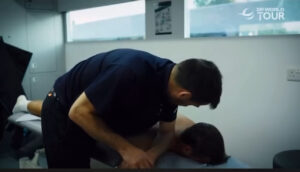
On the physio side, I use a
belt-and-braces approach.
If pain is affecting the swing, I’ll suggest a chat with one of our Sports & Exercise Medicine Physicians about short-term pain relief.
Most players show limited neck rotation when sitting, but this restriction often disappears when lying flat—helping rule out arthritis or major joint pathology. That points to
facet joint irritation, disc sensitivity, or simple muscular overload, rather than anything more serious.
I often describe this as a
sensitised area rather than naming a specific joint or disc. Research by Professor Peter O’Sullivan supports the idea that giving patients a broader, less mechanical explanation helps reduce fear and long-term disability.
Clinically, these symptoms respond well to
soft-tissue work around the upper traps and cervical extensors, particularly targeting trigger points. I’m cautious not to over-rely on massage, as it can dampen muscle activity, so I finish with
gentle neck isometrics to re-activate and stabilise the muscles.
Long-Term Prevention
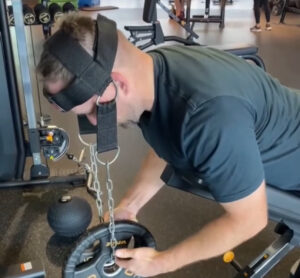
Strong evidence shows that
neck strengthening exercises reduce recurrence rates. We include cervical strength testing as part of player profiling and integrate these exercises into their strength and conditioning programmes.
We also advise players to
manage practice loads carefully and avoid drastic swing changes, both of which can increase injury risk.
Finally, because
stress and poor mental health are major contributors, we encourage players to take genuine rest days away from the course. The recovery truck now includes a small
mental-health space where players can sit in air-conditioned quiet, listen to music, or use guided meditation tracks.
As for the bedding issue—yes, some golfers travel with their own pillows or even mattresses (usually the ones with private jets). For everyone else, it’s worth remembering that the pillow isn’t always the problem.
Key Takeaways
- Around 15% of professional golfers report cervical spine issues during their careers.
- Stress, travel, practice volume, and swing mechanics are the main contributors.
- Neck strengthening, adequate rest, and stress management are the most effective preventive strategies.
- Early physio input, reassurance, and graded activity are key to recovery.
Final Word
Neck pain might not make the highlight reels, but it’s one of the most consistent issues we manage on tour. With better awareness, smarter recovery, and stronger necks, we can keep more players swinging freely—and a lot more happily—through the long DP Tour season.