

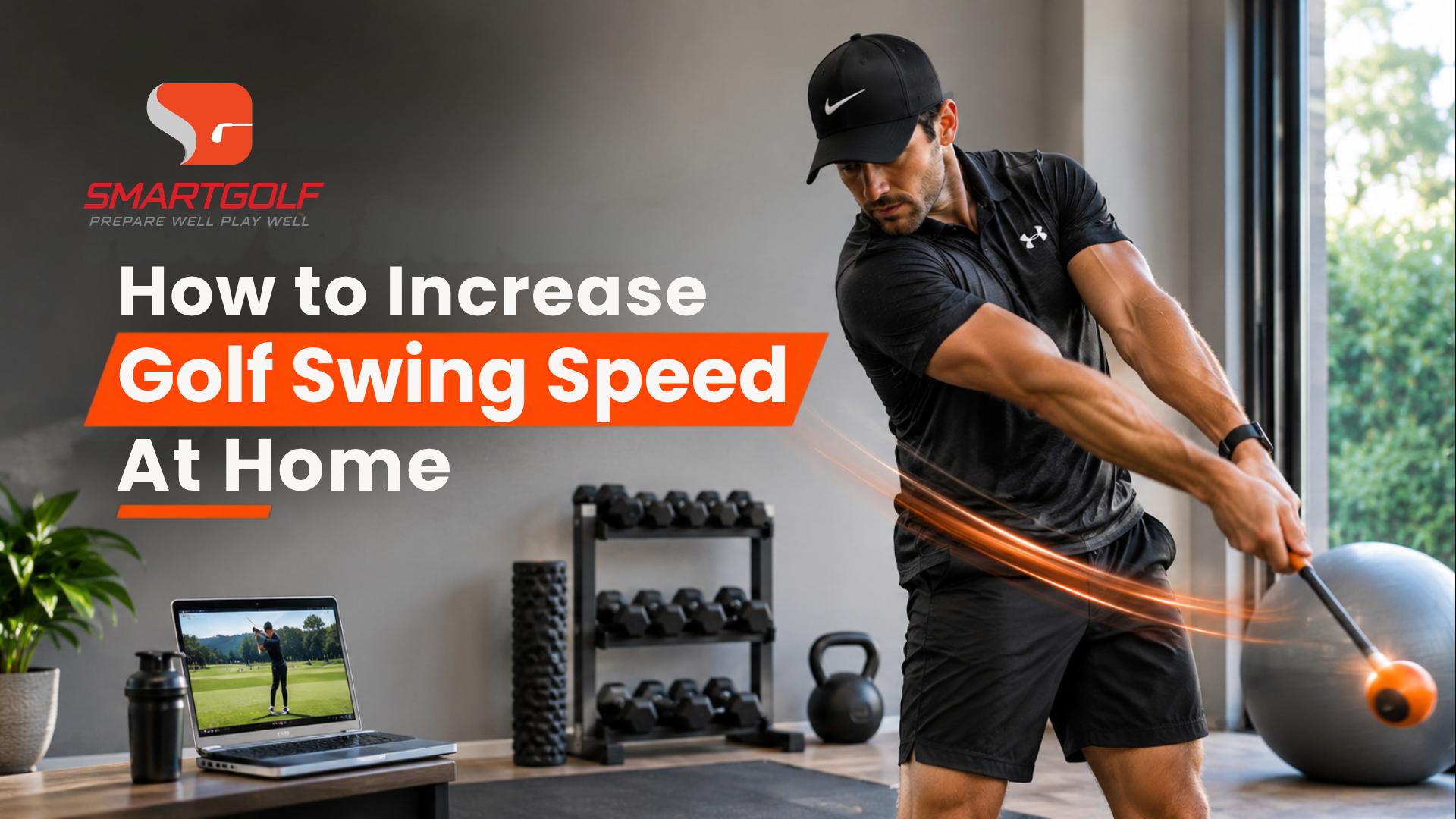

Why swing speed matters
Clubhead speed is the biggest physical factor in how far you hit the ball. As a rough guide, each extra mile per hour of driver speed adds around two to three yards of carry, if you strike it well. More speed also makes the course shorter. That means shorter clubs into greens, which usually means more greens hit and lower scores. And speed you build through training tends to be more reliable than speed you find by swinging out of your shoes.What actually limits your swing speed?
Before you start, it helps to know what holds most golfers back. It is rarely the arms. Usually it is one of these:- A restricted turn. Stiff hips or a stiff upper back shorten your backswing and leave you less distance to build speed.
- Weak legs and hips. Speed starts from the ground. If you cannot push hard into the floor, you have less force to send up the body.
- Slow force production. Some golfers are strong but slow. They have never trained to produce force quickly.
- A body that has never swung fast. If you always swing at 80 percent, your nervous system never learns what faster feels like.
What you need
- A resistance band, ideally a long loop band
- A light medicine ball (2 to 4 kg) or a single dumbbell or kettlebell
- Your driver, or a training stick, and some space to swing safely
- An optional swing speed radar, so you can measure progress
Part 1: Mobility to free up your turn
Do these at the start of every session. They take about five minutes. Open books (8 each side). Lie on your side with your knees bent and stacked. Reach your top arm across and open your chest towards the ceiling, following your hand with your eyes. Keep your knees together so the turn comes from your upper back. Hip 90/90 switches (8 each side). Sit with both knees bent at 90 degrees, one in front and one to the side. Rotate both knees over to the other side without using your hands if you can. This improves the hip rotation you need to turn back and through. Half-kneeling rotations with a club (8 each side). Kneel on one knee with a club across your shoulders. Turn towards the front leg, then away. Keep your hips facing forward. Lunge with reach (6 each side). Step into a long lunge, place the opposite hand on the floor, and reach the other arm to the ceiling.Part 2: Strength from the ground up
Strength gives you more force to work with. These golf workout exercises can be done at home with minimal kit. Goblet squats (3 sets of 8 to 12). Hold a dumbbell or kettlebell at your chest and squat as deep as you can with good control. Slow down on the way down and drive up firmly. DB Rear Elevated Split Squat (3 sets of 8 each leg). Rest your back foot on a chair or sofa and hold a dumbbell in each hand. Your weight shifts onto one leg in the swing, so single-leg strength matters. Start with bodyweight if you are new to it. Single-leg Romanian deadlifts (3 sets of 8 each leg). Hinge forward on one leg, reaching the weight towards the floor with a flat back. This builds the hamstrings and glutes, which drive your hips in the downswing. Glute bridges or hip thrusts (3 sets of 12). Use your sofa for hip thrusts if you can. Strong glutes help you post up on your lead leg. Band Row or Dumb Bell Row (3 sets of 12). Anchor a band in a door, or rest one hand on a bench and row a dumbbell, pulling towards your ribs. This balances the upper body and supports your posture.Part 3: Power so you can use that strength quickly
Power training teaches your muscles to produce force fast. Do it after your workouts for golfers while you are fresh; keep the reps low and move as quickly as you can. Medicine Ball Throw (3 sets of 5 each side). Stand side-on to a sturdy wall in your golf stance. Turn back, then throw the ball into the wall by driving your hips and chest round. If you do not have a solid outdoor wall, a slam into soft ground works too. Goblet Squat Jump (3 sets of 5). Hold a light dumbbell at your chest, squat down slightly, and jump as high as you can. Land softly and reset each rep. Band rotations (3 sets of 8 each side). Anchor a band at chest height and rotate away from it quickly, then return slowly.Part 4: Speed swings
Speed swings are the most specific training you can do. The goal is to swing faster than normal, so your body learns a new top speed. How to do them:- Warm up fully first, including some easy swings.
- Make 5 swings as fast as you can from your normal side, resting 20 to 30 seconds between each.
- Make 3 fast swings from your non-dominant side. This keeps your body balanced, and many golfers find it helps their speed.
- If you use a radar, record your fastest swing each session.
How to increase swing speed without hurting your back
Fast swings put more load through your body, so build up sensibly:- Always warm up. Never make your first swing of the day a fast one.
- Build your base first. Spend two weeks on mobility and strength before adding speed swings.
- Increase speed swings gradually. Start with 10 per session and add a few each week.
- Turn with your hips and upper back. If your hips and upper back cannot rotate, your lower back will try to do it for them.
- Stop if it hurts. Discomfort that is sharp, lasts into the next day or runs down a leg needs assessing before you continue.
Your 4-week home plan
Do three sessions a week with at least one rest day between them. Each session takes 25 to 35 minutes.| Week | Mobility | Strength | Power | Speed swings |
| 1 | All 4 drills | 2 sets of each | None | None |
| 2 | All 4 drills | 3 sets of each | 2 sets of each | None |
| 3 | All 4 drills | 3 sets; add weight if easy. | 3 sets of each | 10 to 15 swings |
| 4 | All 4 drills | 3 sets; add weight if easy. | 3 sets of each | 15 to 25 swings |
Common mistakes
- Only doing speed swings. Without strength and mobility, speed gains stall quickly.
- Training through fatigue. Tired muscles move slowly. Power and speed work should be done fresh.
- Swinging fast with no warm-up. This is one of the quickest ways to strain your back.
- Changing nothing for months. Your body adapts. Add weight, reps or speed gradually.
- Skipping your non-dominant side. Training only one side increases imbalance.
